Simple Ways | How to Tell If a Gold Ring Is Real at Home
When you want to figure out if your jewelry is genuine, learning how to tell if a gold ring is real at home can save you a quick trip to the pawn shop. Finding an old ring tucked away in a drawer always brings up a big question: is it actually real gold or just a clever fake imitation?
While taking it to a professional is always the safest route, you do not need advanced lab tools to check it yourself. You can easily test your ring right at home using a few simple and safe methods.
Checking Hallmarks to Verify a Real Gold Ring at Home
The first step in checking your jewelry is to look closely at its physical surface. When learning how to tell if a gold ring is real at home, remember that real gold jewelry usually features a tiny stamp or hallmark located on the inside band of the ring.
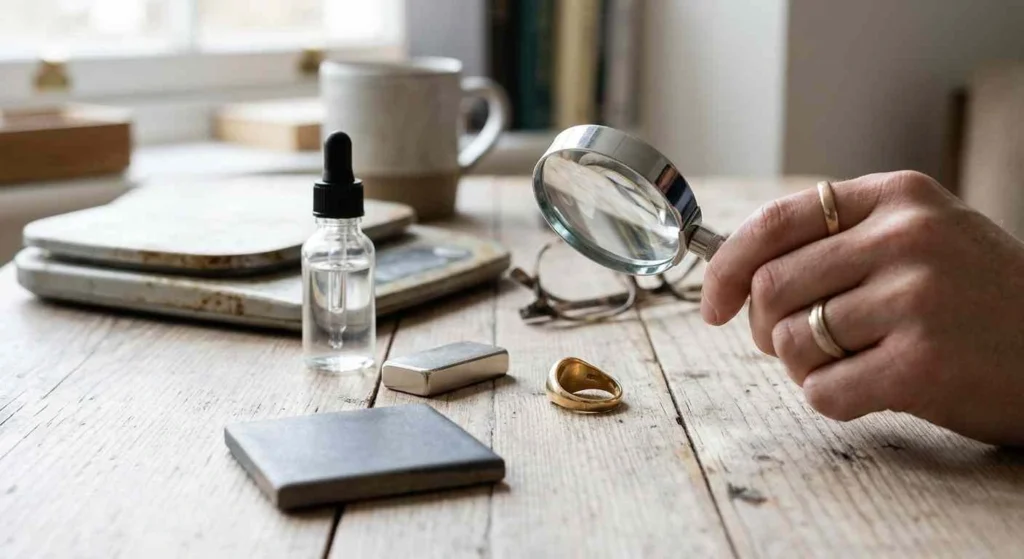
Take a magnifying glass or use your smartphone camera’s zoom feature. Look for numbers like 10K, 14K, 18K, 22K or numbers like 417, 585, 750, 916 and 999. These stamps show the exact purity of the metal.
However, keep in mind that fake rings can also carry fraudulent stamps. Look out for letters like GP (Gold Plated), GF (Gold Filled) or HGE (Heavy Gold Electroplate), which mean the ring is not solid gold. If you see blurry or uneven markings, you should use other tests to be sure.
Understanding Solid Gold vs. Gold-Plated Jewelry
Before running tests, it helps to know what you are looking at beneath the surface:
- Solid Gold: The entire ring is made of gold alloy throughout its thickness. Even if it gets scratched deeply, the metal underneath is still gold.
- Gold-Plated / Gold-Filled: These rings have a base metal (like brass, copper or silver) on the inside, covered by a thin layer of real gold on the outside. Over time, friction wears down this outer layer, exposing the cheap metal underneath.
Using a Magnet to Test a Gold Ring at Home
The magnet test is a quick way to screen your jewelry. Pure gold is not a magnetic metal at all. When people ask how to tell if a gold ring is real at home, this quick test is often the first one they try.
Take a strong refrigerator magnet and hold it right next to your ring. If the ring jumps or sticks firmly to the magnet, it is likely not solid gold.
Important note: Non-magnetic results do not guarantee your ring is real, because many base metals are also non-magnetic. Also, if your ring has a clasp or a spring mechanism, it may contain steel components that will react to a magnet even if the rest of the piece is genuine.
Skin and Sweat Test and Common Reactions
Everyday wear can often tell you a lot about your jewelry over time. If you wear a ring regularly during daily routines, pay attention to your skin.
Real gold is chemically stable and generally does not react with body sweat or skin oils. However, low-karat gold (like 10K or 14K) contains copper, nickel and other alloy metals. In some cases, even real low-karat gold can leave a mild mark due to friction or a reaction with body chemistry.
If your ring leaves a dark, bright green or black stain quickly, it is a strong indicator that the outer layer has worn off, exposing base metals underneath.
The Density and Weight Test (Archimedes’ Principle)
Gold is a remarkably heavy and dense metal compared to most base metals. When figuring out how to tell if a gold ring is real at home, you can test its density using a digital kitchen scale:
- Weigh your gold ring on the scale in grams and note down the exact weight.
- While real gold is much denser and heavier for its size than brass or copper, this test requires precise measurements, so it works best alongside other home checks rather than standing alone.
The Vinegar Drop Test for a Quick Check
You can use common household white vinegar to perform a rough surface check on your ring.
Place your ring on a clean surface and put one small drop of vinegar directly onto the metal. Wait for about one to two minutes. Vinegar is a mild acid but it is not strong enough to affect solid gold.
Keep in mind that this is only a rough check because many fake metals also will not react with mild vinegar. If the metal bubbles or changes color, it is likely plated or fake. Always rinse your ring with clean water right after.
Ceramic Plate Scratch Method (Use With Caution)
This method helps check streak color but it is not recommended for valuable, antique or plated rings, as it can damage the surface or wear away thin gold plating.
Find an unglazed white ceramic tile or plate. Drag the ring lightly across the rough surface. If it leaves a dark or grey streak, the ring is made of base metal. If it leaves a soft golden-yellow streak, it points toward real gold. Do this gently on a hidden part of the band.
When to Visit a Professional Jeweler
Home tests are helpful for a quick check, but they are not 100% foolproof. If you have a high-value piece or need an exact purity check, visit a local jeweler. They can use professional tools like an electronic gold tester, nitric acid kits or X-ray fluorescence (XRF) machines without harming your jewelry. When you master how to tell if a gold ring is real at home, visiting a jeweler becomes much easier because you already know what to expect.
To see real-world experiences and community discussions on how to tell if a gold ring is real at home, you can also check out this helpful Reddit thread.
Conclusion & Finding Your Perfect Fit
Testing a ring at home is a great way to get a quick idea of whether your jewelry is genuine, but combining hallmark checks, the magnet test and skin observations gives you the clearest picture. Ultimately, learning how to tell if a gold ring is real at home empowers you as a jewelry owner. For high-value heirlooms, always trust a certified professional.
Frequently Asked Questions
Q1: Does real gold turn skin green?
Answer: Solid high-purity gold (like 18K or 24K) does not turn skin green. However, low-karat gold (like 10K) contains copper and other alloys that can sometimes react with skin lotions, sweat or body chemistry to leave a faint mark.
Q2: Is the water sink test reliable for checking gold?
Answer: No, the water test is unreliable. While real gold is dense and sinks quickly, many heavy base metals used in fake jewelry have a similar weight and will also sink to the bottom immediately.
Q3: Can I use a lighter to check if a gold ring is real?
Answer: No, using a flame or lighter is dangerous. It can melt lower-melting-point metals, warp your jewelry, burn gemstones and permanently ruin a ring even if it is real.