Diamond vs Moissanite Rings: Key Differences to Know
Diamond and moissanite are different gemstones, and both can work well in an engagement ring. Diamond has greater hardness, while moissanite shows stronger rainbow fire and usually costs less. Your best choice depends on appearance, budget, stone size and daily wear, making Diamond vs Moissanite Rings an important comparison before choosing an engagement ring.
| Feature | Diamond | Moissanite |
|---|---|---|
| Composition | Carbon | Silicon carbide |
| Mohs hardness | 10 | 9.25 |
| Brilliance | Very high | Very high |
| Fire | Less pronounced | More pronounced |
| Origin | Natural or laboratory grown | Usually laboratory created |
| Typical price | Higher | Lower |
| Everyday wear | Excellent | Excellent |
| Light appearance | Strong white sparkle with fire | Strong sparkle with more rainbow flashes |
Diamond is crystallized carbon, while moissanite is silicon carbide. GIA lists diamond at 10 on the Mohs hardness scale. Moissanite measures about 9.25, so both are hard enough for regular ring wear.
What Is the Difference Between a Diamond and Moissanite?
A natural diamond forms deep inside the Earth over a very long period. A laboratory grown diamond is also diamond, with essentially the same chemical composition, crystal structure and physical and optical properties as a natural diamond. Its difference is its origin.
Moissanite is a separate gemstone. Its chemical composition is silicon carbide not carbon. Natural moissanite is extremely rare, so the material used in modern jewelry is generally created in a laboratory. You can learn more about moissanite’s composition, history and physical properties in this Wikipedia overview.
This distinction matters when shopping online. Diamond vs Moissanite Rings involve different gemstones, even though both can offer a similar appearance. A laboratory grown diamond is still a diamond, while moissanite is a separate gemstone.
Moissanite vs Diamond Engagement Rings: Which Looks Better?
There is no single answer because the two stones interact with light differently.
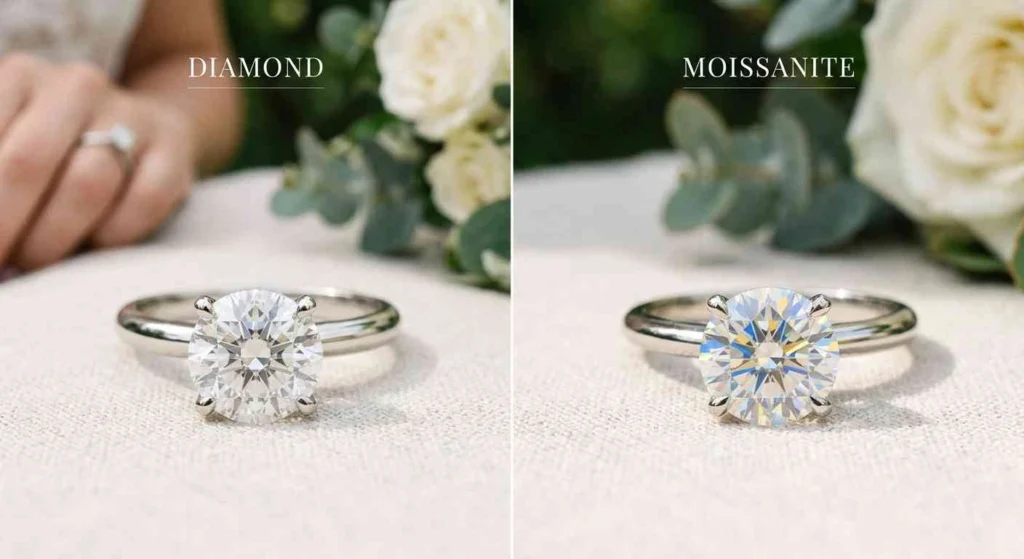
Diamond produces brilliance, sparkle and fire. Moissanite is also highly brilliant, but its fire can be more noticeable. GIA describes moissanite as having more pronounced fire and strong brilliance, which can create visible rainbow flashes under suitable lighting.
If you prefer mostly white flashes, diamond may suit your taste. If you enjoy stronger colored flashes, moissanite may stand out more.
Cut also matters. A diamond’s proportions and facet arrangement affect how light returns to the eye, which is why two diamonds with the same carat weight can look quite different.
How Does Size Affect a Diamond or Moissanite Ring?
One point often causes confusion: carat measures weight not the visible size of a stone.
GIA defines one metric carat as 200 milligrams. Diamond value is not based on weight alone. Cut, color and clarity also affect its quality and price.
This is why a 2 carat moissanite vs 2 carat diamond ring cost difference cannot be predicted from carat weight alone.
Two stones with the same stated weight can have different dimensions, proportions and prices. Shape matters too. An oval stone for example, can have a different face up appearance from a round stone at a similar weight.
When comparing an oval moissanite with an oval diamond, check the actual measurements rather than relying only on the carat number.
Diamond vs Moissanite Rings: Side-by-Side Comparison
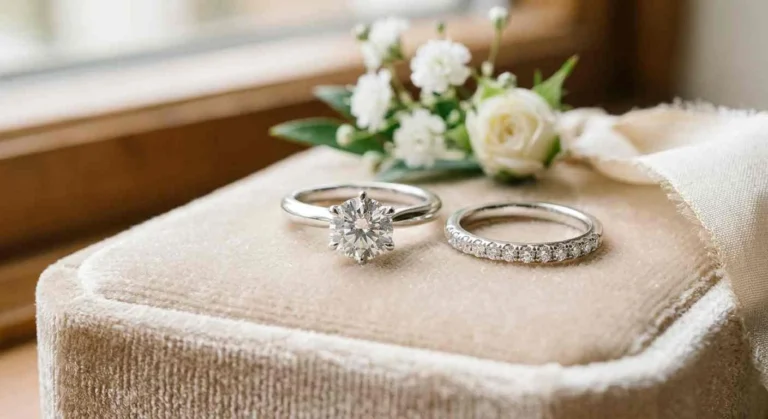
For a side-by-side comparison, choose stones with the same shape and similar dimensions. Compare their sparkle, rainbow flashes, color, facet pattern and overall appearance under different lighting.
Diamond vs Moissanite Rings: Cost Comparison
For many buyers, price is the biggest practical difference.
Moissanite generally costs less than a comparable diamond, which can make a larger center stone possible within the same budget. The actual price still depends on factors such as size, shape, quality, setting, metal and seller.
Diamond pricing has several variables. GIA uses the four Cs, cut, color, clarity and carat weight, to describe diamond quality. Carat weight alone does not determine the price.
There is another important comparison to make. A natural diamond and a laboratory grown diamond are both diamond, but their origins differ. Laboratory grown diamonds are produced using methods such as HPHT or CVD and have essentially the same chemical and physical properties as natural diamonds.
So if your budget allows either a moissanite or a diamond, decide first whether you are comparing moissanite with a natural diamond or a laboratory grown diamond.
How Durable Is Moissanite for Everyday Wear?
Diamond is harder, with a Mohs hardness of 10. Moissanite measures about 9.25. That makes moissanite highly resistant to everyday scratching and suitable for regular jewelry wear.
Hardness does not mean a ring cannot be damaged. The stone’s setting, prongs, band and overall construction also affect how well the finished ring handles daily use.
Diamond can also be damaged under the right conditions. Its high hardness mainly describes resistance to scratching. It does not make the entire gemstone or ring impossible to chip or damage.
Lab Grown Diamond vs Moissanite
These two are often confused because both can be laboratory created but they are not the same material.
A laboratory grown diamond has the same basic carbon crystal structure as a natural diamond. Moissanite is silicon carbide. GIA states that laboratory grown diamonds have essentially the same chemical, physical and optical properties as natural diamonds.
The choice therefore comes down to what you actually want. Choose laboratory grown diamond when you want diamond material with a laboratory origin. Consider moissanite when you want a different gemstone with strong brilliance, pronounced fire and a lower typical purchase price.
Which Should You Choose?
Choose moissanite if your priorities are lower cost, strong sparkle, pronounced rainbow fire, durability and a laboratory created gemstone.
Choose diamond if you specifically want diamond, place greater importance on its hardness or prefer its particular light performance and traditional identity.
Consider laboratory grown diamond if you want diamond material but prefer a laboratory origin rather than a naturally formed stone. GIA confirms that laboratory grown diamonds have essentially the same chemical, physical and optical properties as natural diamonds.
Diamond vs Moissanite Rings: Frequently Asked Questions
Is Moissanite a Precious Stone?
Ans. Moissanite is a gemstone made from silicon carbide. It is different from diamond and is generally produced in laboratories for jewelry because natural moissanite is extremely rare.
Can Diamonds Get Scratched?
Ans. Diamond is the hardest mineral on the Mohs scale at 10, so it has excellent scratch resistance. However, hardness does not make a diamond ring immune to every type of damage.
Is a 2 Carat Moissanite the Same Size as a 2 Carat Diamond?
Ans. Not necessarily. Carat measures weight. Physical dimensions depend on the stone’s shape, proportions and depth. GIA also notes that equal carat weight does not mean equal diamond value or appearance.