Ring Setting Guide | Key Features & Basics
A ring setting is the metal piece that locks your gem in place. People usually look at the diamond first, but the setting is what keeps the stone safe, helps it catch the light and makes sure the ring doesn’t feel uncomfortable on your finger.
Following a practical ring setting guide and knowing how different setting styles, band widths, metals and ring heights match up helps you find a design that fits your everyday routine and budget.
Popular Ring Setting Styles
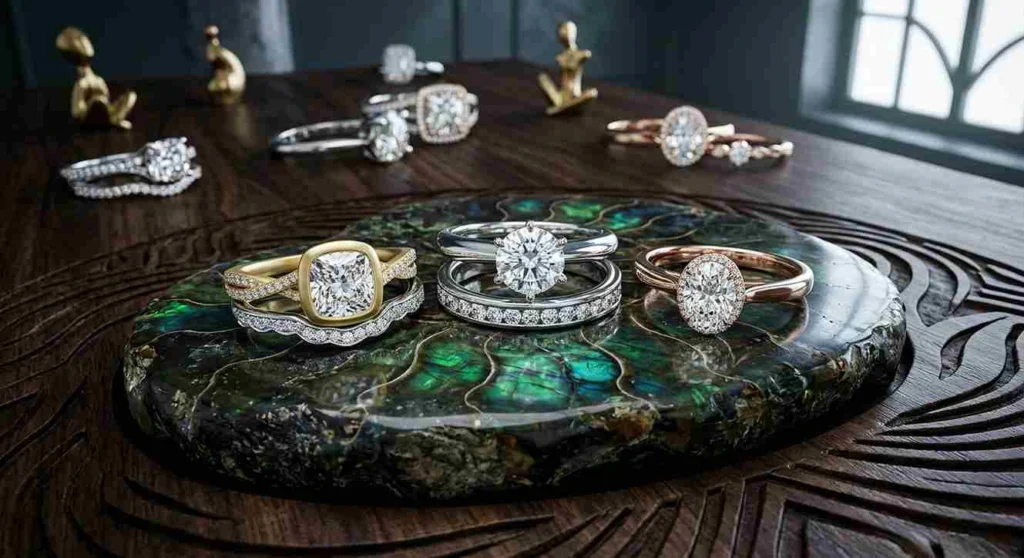
Setting designs fall into three main categories based on how they hold the gem and frame the ring from the top view. For a quick visual breakdown of these styles, you can check out this helpful ring settings chart on Reddit.
Classic Options
- Solitaire: Holds one single gem on a plain band. It focuses all attention on the main diamond and costs less, but any minor flaws or color tint show more easily.
- Prong: Uses 4 or 6 metal claws to grab the diamond. It lets in maximum light for the best sparkle, but the raised claws can snag on clothes and loosen over time.
- Bezel: Wraps a smooth metal rim all the way around the gem. It protects the edges from bumps and prevents snagging, but blocks side light so the diamond sparkles slightly less.
Decorative & Vintage Styles
- Halo: Rings the main gem with small accent diamonds. It makes your center stone look noticeably larger on a budget, but dirt collects underneath, so it needs regular cleaning.
- Cathedral: Uses sloped metal arches to lift the center stone higher off the band. It gives the ring an elegant profile and adds extra side support against accidental bumps.
Modern Engineered Styles
- Pavé: Sets small diamonds closely along the band with tiny prongs for nonstop shimmer. It requires gentle care and full pavé bands are hard to resize.
- Channel: Places small stones inside a metal groove between solid walls. The gems stay safe from bumps and won’t snag on clothes, making it great for active daily wear.
- Tension: Uses a spring-loaded metal band to squeeze the diamond from two sides, making it look floating. It needs strong metals and can’t be resized normally.
Band Width | Thin vs. Thick Bands
The physical width of the metal band affects overall durability, comfort and how large your diamond appears on your hand.
Thin Bands (1.5mm – 2.0mm)
A thin band keeps the metal minimal so your center diamond really stands out. It feels light on the finger and slides neatly next to a straight wedding ring. Jewelers usually suggest staying around 1.8mm to 2.0mm for a delicate look that is still safe for daily wear, since anything thinner than 1.5mm can easily bend or warp during workouts or heavy hands-on work.
Thick Bands (2.5mm – 4.0mm+)
Thicker bands give you more strength and durability, so they resist dents, scratches and bending over years of daily wear. The extra metal leaves plenty of space for custom engravings, detailed patterns or small set stones. Plus, a wider band helps balance larger or top-heavy diamonds so the ring stays upright instead of spinning sideways on your finger.
Practical Comfort & Sizing Tips
- Sizing Up for Wide Bands: Wider bands cover more skin, trapping heat and causing friction. Jewelers usually recommend going up by a quarter to a half size for bands wider than 3.5mm. (If you aren’t sure of your fit, check our online ring size calculator before buying a wide band).
- Finger Proportions: Slim bands make shorter fingers look longer, while wider bands naturally complement longer or larger hands.
- Metal Choice & Durability: Metal type affects long-term wear. Platinum is dense and highly durable, making it great for ultra-thin bands and heavy settings alike. 14k gold offers solid strength for daily wear, while softer 18k gold holds up best with a slightly thicker band.
Side Profile and Setting Height
Looking at your ring from the side reveals its height from the finger base, its basket structure and its underlying metal support.
High Profile vs. Low Profile
- High-Profile Settings: Position the stone elevated above the band. Open side arches let light enter freely to maximize sparkle. However, taller settings catch more easily on glove edges, clothing pockets and car doors.
- Low-Profile Settings: Mount the gem close to the band surface. Sitting close to your skin, low settings reduce leverage from accidental bumps, making them ideal for healthcare workers, athletes or manual craftspeople. A total height around 6mm to 7mm from finger to top facet is generally considered a balanced clearance for daily wear.
Hidden Details and Wedding Stacks
- Hidden Details: The side profile provides space for subtle design accents, such as a micro-halo ring beneath the basket, filigree scrollwork or small flush-set birthstones along the inner bridge.
- Flush Stacking: If the main head sits raised above the metal band, a standard straight wedding band can slide underneath smoothly without leaving a gap. If the setting basket rests low against the band, a straight band will bump into the head, requiring a contoured or curved wedding ring to sit tight.
Complete Ring Setting Comparison
| Setting Style | Setting Height | Relative Cost Range | Durability | Light Reflection | Maintenance Level | Best Fit For |
| Solitaire | Low to High | Budget-Friendly | Moderate | High | Low | Classic minimalism & lower budget |
| Prong | High | Budget-Friendly | Moderate | Very High | Medium (Annual claw checks) | Maximum brilliance & light entry |
| Bezel | Low | Moderate | High | Moderate | Very Low | Active lifestyles & heavy hand use |
| Halo | Medium to High | Moderate | Moderate | High | High (Frequent cleaning) | Larger visual presence on a budget |
| Cathedral | High | Moderate | High | High | Low-Medium | Graceful profile with added structure |
| Pavé | Low to Medium | High | Low-Moderate | High | High (Careful handling) | Continuous band shimmer |
| Channel | Low / Flush | Moderate | High | Moderate | Low-Medium | Smooth bands & active routines |
| Tension | High | Premium | High | High | Low (Hard to resize) | Bold, modern floating stone look |
Frequently Asked Questions
Q1: Which ring setting is the safest for daily hands-on wear?
Ans: The bezel setting offers the highest physical security. By wrapping a solid rim of metal around the gem’s perimeter, it shields fragile corners from chipping and eliminates claws that can snag on clothing or gloves.
Q2: Will choosing a wider band make my main diamond look smaller?
Ans: Yes. A wider band places more metal around the gem, which creates visual balance and can make the center diamond appear slightly smaller compared to an ultra-thin 1.8mm band.
Q3: How often should I get my ring setting inspected by a jeweler?
Ans: It is best to have your ring inspected every 6 to 12 months. A quick professional check catches loose stones, worn prongs or bent metal early before a gemstone falls out.
Q4: Can all ring settings be resized easily if my finger size changes?
Ans: No. Standard solitaire, bezel and plain prong rings can usually be resized up or down by 1–2 sizes. However, styles with diamonds set around the band (like full pavé) or precision tension settings cannot be resized using standard techniques without rebuilding the ring.